Federal Rule Will Disrupt Federal Grants
The most consequential federal funding rule change ever will go into effect December 12, 2026. Under this proposed rule, every single entity that receives federal grant money or pass-through will be subject to new federal regulations. This includes nonprofits, local governments, school districts, subcontractors, for-profit businesses, etc.
The proposed rule will affect every single federal grant dollar, and all public facilities regardless of funding.
Here are just a few of the provisions:
• Discretionary grants can be canceled ANY TIME for ANY REASON. No warning, no objections, and no appeal process.
• Senior political appointees review ALL discretionary grant awards. They may cancel any discretionary award without cause, and the proposed rule expressly allows for mass terminations of awards.
• Prohibits use of federal funds for activities conflicting with the current president’s priorities.
• Prohibits policies and initiatives that conflict with President Trump’s 2025 Executive Orders involving Diversity, Equity and Inclusion, gender ideology, “anti-American” values, etc.
This is not legislation passed by Congress. Instead, it is a federal rule proposed by the Office of Management and Budget (OMB). The OMB Director is appointed by the President of the United States. The current OMB Director is Russell T. Vought.
- Example #1: How New Federal Rule Impacts You (PDF, 3133.4k)
- Example #2: How New Federal Rule Impacts You (PDF, 3157.3k)
- OMB Federal Rule Changes (PDF, 3055.8k)

What else can I do to help?
Contact your Congressional Representatives
Congress delayed the implementation of this rule through December 11, 2026.
If you or a loved one has utilized services or organizations funded with federal grants—such as HeadStart, Meals on Wheels, public universities, public housing, addiction or recovery services, a specialized court docket, SNAP, Medicaid, and much more—it is important to share your story about how these services benefited you. This new rule will disrupt these services, programs, and much more.
Senator Jon Husted
Washington, DC: (202) 224-3353
Cleveland Office: (216) 539-7877
Columbus Office: (614) 369-4925
Senator Bernie Moreno
Washington, DC: (202) 224-2315
Cleveland Office: (216) 522-7272
Columbus Office: (614) 469-2083
Representative Emilia Sykes
Washington, DC: (202) 225-6265
Akron Office: (330) 400-5350
Canton Office: (330) 400-5350

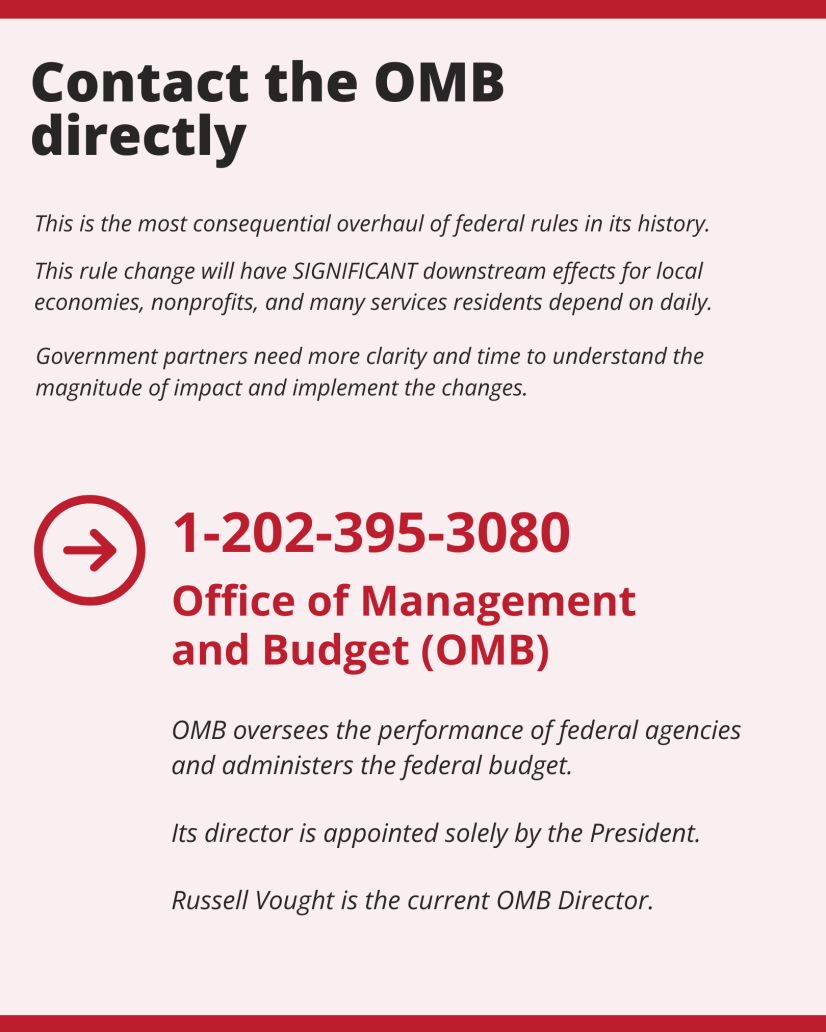
Contact the OMB Directly
Call 1-202-395-3080
Email MBX.OMB.Grants@OMB.eop.gov.
OMB oversees the performance of federal agencies and administers the federal budget.
Its director is appointed by the President of the United States.
Russell T. Vought is the current OMB Director.
View the Proposed Rule
https://www.regulations.gov/document/OMB-2026-0034-0001
Stay updated by following the Summit County Executive's Office on Facebook: https://www.facebook.com/SummitCountyExecutive/
Summit County Executive Ilene Shapiro submitted public comment out of deep concerns for the services, programs, and financial stability and ability to plan over multiple years if this proposed rule was to take effect. You can read her full comment in the link below.
- Executive Shapiro's Public Comment to OMB (PDF, 388.4k)
Public Comment Information (Public Comment Period Closed)
Public comment isn't scary or just for agencies that receive the funding! Anyone can comment or review other's comments.
If you or a loved one has utilized services or organizations funded with federal grants—such as HeadStart, Meals on Wheels, public universities, public housing, addiction or recovery services, a specialized court docket, SNAP, Medicaid, and much more—it is important to share your story about how these services benefited you.
Your input could help protect these services from elimination.
This is a real concrete way you can take action. Public comment is due Monday, July 13, at 11:59pm.
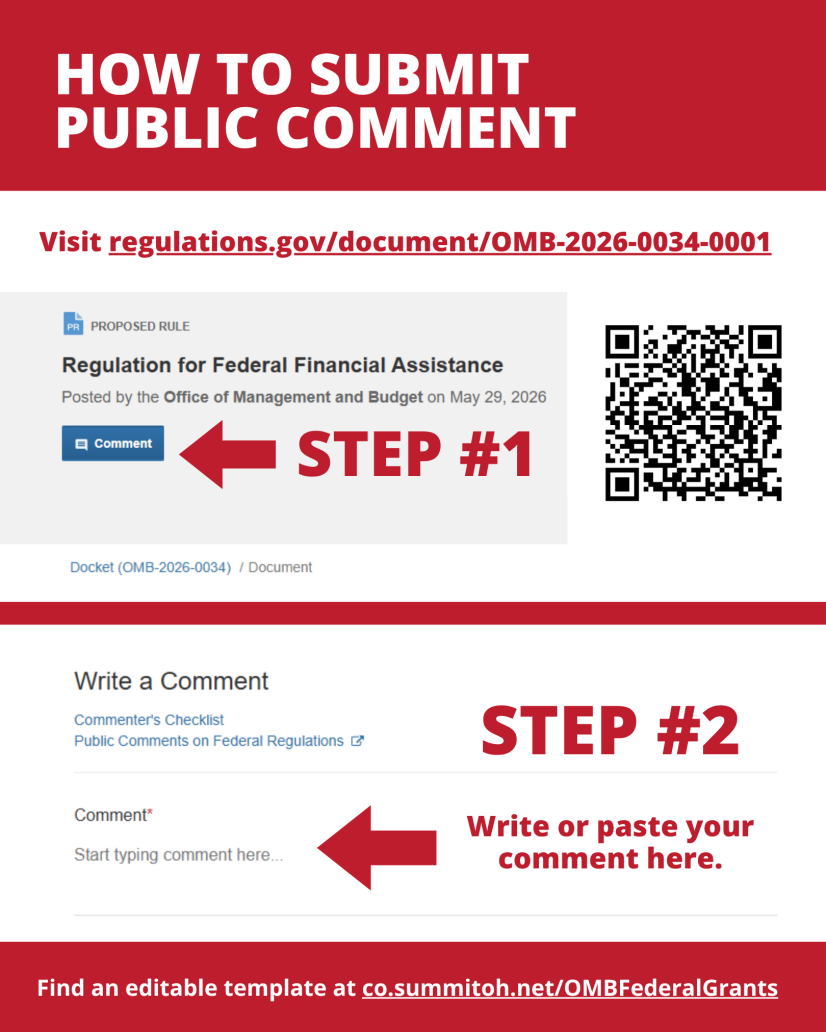
Visit https://www.regulations.gov/document/OMB-2026-0034-0001 and follow these 4 easy steps.
- Click on "Comment."
- Write or paste your comment (suggested template can be found below).
- You can choose to remain anonymous or identify yourself as an individual or organization. (Email address is optional!)
- Click "Submit Comment."
Not sure what to say?
Copy the language below into the comment textbox and add your own personal experience:
[About me: Who I am and my connection to my community — resident, parent, small-business owner, nonprofit staff or volunteer, patient or client, etc]
[Why federal funding is important to me: The specific federally funded service or program I or someone I love relies on (for example: SNAP, Head Start, Meals on Wheels, a public university, public housing, addiction or recovery services, a specialized court docket). Name it and describe what it does for me.]
[How this rule would change things for me: For example, if funding could be terminated mid-year, if the program had to cut services, if my organization decided to apply for fewer grants because of the added burden, or if I lost access to a service I depend on. Describe the real, specific consequence in my life.]
[My judgment: whether I think OMB is heading in the right or wrong direction here, and why.]
For these reasons, I would encourage OMB to:
- Remove the newly expanded termination authority, or at minimum limit the authority and establish clear, predictable procedures — including notice and a meaningful opportunity to cure before funding is cut off [§§200.340–200.343]
- Narrow the new event-services requirements so they apply only to events actually supported with federal funds [§200.219]
- Clearly define the terms in the new funding-condition rules before they take effect [§200.300(b)]
- Remove §200.339(b), or at minimum define "cooperate" and require notice and an opportunity to cure before an agency may assist a private party [§200.339(b)]
- Provide adequate transition time and technical assistance before new requirements take effect [§§200.303, 200.305, 200.329, 200.332]
- Preserve notice-and-comment rulemaking so the public can weigh in on future changes [§1.105; §200.110]
- Extend the public comment period by at least 45 days
- Publish a fiscal impact analysis on states and localities before finalizing the rule
- Delay implementation until at least October 1, 2027
- How to Submit Public Comment (PDF, 139.6k)
- Community Comment Letter Template (Word Document, 20.6k)
Ohio Building - 8th Floor
175 South Main Street
Akron, OH 44308
Main Phone:
(330) 643-2510